Sign out

Top of the pageCheck Your Symptoms
Overview
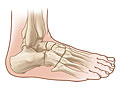
Everyone has had a minor problem with a toe, foot, or ankle. Most of the time our body movements don't cause problems. But sometimes symptoms develop from everyday wear and tear or overuse. Toe, foot, or ankle problems can also occur from injuries or the natural process of aging.
Your toes, feet, or ankles may burn, sting, or hurt. They may feel tired, sore, stiff, numb, tingly, hot, or cold. You may have had a "charley horse" (muscle cramp) in your foot while lying in bed at night. Your feet or ankles may change color or swell. You may have noticed an embarrassing odor from your feet. Some changes in your feet and ankles are normal as you age. Age-related changes include your foot spreading and your nails getting thick and brittle. Some changes are common during pregnancy. For example, your ankles and feet may swell. Home treatment is usually all that's needed to relieve your symptoms.
Toe, foot, or ankle problems may be caused by an injury. But there are many noninjury causes of toe, foot, or ankle problems.
Skin problems
Most skin problems that affect your feet are more annoying than they are serious. If you have:
- The feeling of walking on pebbles: You may have plantar warts on the bottom of your feet.
- Patches of thick and tough skin on the heel or ball of your foot: You may have a callus, corn, blister, or skin growth.
- Red, peeling, cracking, burning, and itchy skin between your toes or on the bottom of your feet: You may have athlete's foot. Or maybe your feet are reacting to the shoes you wear (shoe dermatitis).
- Red, swollen, and painful skin around a toenail: You may have an ingrown nail or an infection around your nail (paronychia).
- Red, swollen soles of your feet that are painful to the touch or when you walk: You may have a bacterial infection. Public showers, hot tubs, or swimming pools are common areas where bacterial infections, athlete's foot, and warts can be spread to your feet.
Joint problems
Toe joints are more likely to have problems than other joints in your feet.
- Heat, pain, redness, swelling, and extreme tenderness that comes on quickly in your big toe joint may be caused by gout. Similar symptoms can occur with an infection.
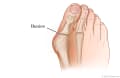
- If you have swelling or a bump at the base of your big toe, you may have a bunion.
- If you have a bump on the outside of your little toe, you may have a bunionette, also called a Tailor's bunion.
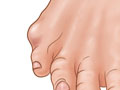
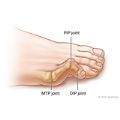
- If your toes, other than your big toes, bend in an odd position, you may have hammer toes, mallet toes, or claw toes.
- Joint pain, stiffness, and swelling are common when you have conditions such as bursitis, arthritis, lupus, or gout.
Pain
You may have pain in the front (ball) of your foot (metatarsalgia) or in your heel. Heel problems often occur when you overuse calf muscles, wear shoes with high heels, or do activities, such as running, that cause repeated pounding on your heels.
- Sharp pain on the bottom of your heel may be caused by plantar fasciitis.
- Pain in the back of your heel and ankle may be caused by Achilles tendinitis or tendinosis (tendinopathy) or retrocalcaneal bursitis.
- Pain that's worse before or after exercise but improves during exercise may be caused by a stress fracture of a bone in your foot (usually a metatarsal bone).
- Small bony growths under your heel bone may be a heel spur.
- Pain in the middle of your foot may be caused by "fallen arches" or by being flat-footed.
- Pain or a bump on the back of the heel is a type of bursitis called Haglund's deformity.
Numbness or tingling
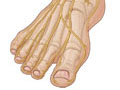
Many conditions may affect the nerves of the foot and cause numbness, tingling, and burning.
- Pain, burning, tingling, or numbness that occurs between your toes, especially the third and fourth toes, and in the ball of your foot may be caused by a growth around the nerves (Morton's neuroma).
- Pain, numbness, and tingling that starts in your back or buttock and moves down your leg and into your foot may be sciatica. It's caused by a pinched nerve (nerve root compression).
- Foot and ankle pain that occurs with numbness and weakness in your foot may be caused by a pinched nerve in your ankle (tarsal tunnel syndrome) or back (sciatica).
- Burning, numbness, or lack of feeling in your feet may be caused by poor circulation. This is most common in people who have diabetes or peripheral arterial disease. The circulation problem can lead to nerve damage (peripheral neuropathies). Foot problems are more likely to occur in people who have these conditions.
Health Tools
Health Tools help you make wise health decisions or take action to improve your health.
Check Your Symptoms
The medical assessment of symptoms is based on the body parts you have.
- If you are transgender or nonbinary, choose the sex that matches the body parts (such as ovaries, testes, prostate, breasts, penis, or vagina) you now have in the area where you are having symptoms.
- If your symptoms aren’t related to those organs, you can choose the gender you identify with.
- If you have some organs of both sexes, you may need to go through this triage tool twice (once as "male" and once as "female"). This will make sure that the tool asks the right questions for you.
Many things can affect how your body responds to a symptom and what kind of care you may need. These include:
- Your age. Babies and older adults tend to get sicker quicker.
- Your overall health. If you have a condition such as diabetes, HIV, cancer, or heart disease, you may need to pay closer attention to certain symptoms and seek care sooner.
- Medicines you take. Certain medicines, such as blood thinners (anticoagulants), medicines that suppress the immune system like steroids or chemotherapy, herbal remedies, or supplements can cause symptoms or make them worse.
- Recent health events, such as surgery or injury. These kinds of events can cause symptoms afterwards or make them more serious.
- Your health habits and lifestyle, such as eating and exercise habits, smoking, alcohol or drug use, sexual history, and travel.
Try Home Treatment
You have answered all the questions. Based on your answers, you may be able to take care of this problem at home.
- Try home treatment to relieve the symptoms.
- Call your doctor if symptoms get worse or you have any concerns (for example, if symptoms are not getting better as you would expect). You may need care sooner.
Pain in children under 3 years
It can be hard to tell how much pain a baby or toddler is in.
- Severe pain (8 to 10): The pain is so bad that the baby cannot sleep, cannot get comfortable, and cries constantly no matter what you do. The baby may kick, make fists, or grimace.
- Moderate pain (5 to 7): The baby is very fussy, clings to you a lot, and may have trouble sleeping but responds when you try to comfort him or her.
- Mild pain (1 to 4): The baby is a little fussy and clings to you a little but responds when you try to comfort him or her.
Pain in children 3 years and older
- Severe pain (8 to 10): The pain is so bad that the child can't stand it for more than a few hours, can't sleep, and can't do anything else except focus on the pain. No one can tolerate severe pain for more than a few hours.
- Moderate pain (5 to 7): The pain is bad enough to disrupt the child's normal activities and sleep, but the child can tolerate it for hours or days.
- Mild pain (1 to 4): The child notices and may complain of the pain, but it is not bad enough to disrupt his or her sleep or activities.
When an area turns blue, very pale, or cold, it can mean that there has been a sudden change in the blood supply to the area. This can be serious.
There are other reasons for color and temperature changes. Bruises often look blue. A limb may turn blue or pale if you leave it in one position for too long, but its normal color returns after you move it. What you are looking for is a change in how the area looks (it turns blue or pale) and feels (it becomes cold to the touch), and this change does not go away.
Certain health conditions and medicines weaken the immune system's ability to fight off infection and illness. Some examples in adults are:
- Diseases such as diabetes, cancer, heart disease, and HIV/AIDS.
- Long-term alcohol and drug problems.
- Steroid medicines, which may be used to treat a variety of conditions.
- Chemotherapy and radiation therapy for cancer.
- Other medicines used to treat autoimmune disease.
- Medicines taken after organ transplant.
- Not having a spleen.
Pain in adults and older children
- Severe pain (8 to 10): The pain is so bad that you can't stand it for more than a few hours, can't sleep, and can't do anything else except focus on the pain.
- Moderate pain (5 to 7): The pain is bad enough to disrupt your normal activities and your sleep, but you can tolerate it for hours or days. Moderate can also mean pain that comes and goes even if it's severe when it's there.
- Mild pain (1 to 4): You notice the pain, but it is not bad enough to disrupt your sleep or activities.
Symptoms of infection may include:
- Increased pain, swelling, warmth, or redness in or around the area.
- Red streaks leading from the area.
- Pus draining from the area.
- A fever.
Seek Care Now
Based on your answers, you may need care right away. The problem is likely to get worse without medical care.
- Call your doctor now to discuss the symptoms and arrange for care.
- If you cannot reach your doctor or you don't have one, seek care in the next hour.
- You do not need to call an ambulance unless:
- You cannot travel safely either by driving yourself or by having someone else drive you.
- You are in an area where heavy traffic or other problems may slow you down.
Seek Care Today
Based on your answers, you may need care soon. The problem probably will not get better without medical care.
- Call your doctor today to discuss the symptoms and arrange for care.
- If you cannot reach your doctor or you don't have one, seek care today.
- If it is evening, watch the symptoms and seek care in the morning.
- If the symptoms get worse, seek care sooner.
Make an Appointment
Based on your answers, the problem may not improve without medical care.
- Make an appointment to see your doctor in the next 1 to 2 weeks.
- If appropriate, try home treatment while you are waiting for the appointment.
- If symptoms get worse or you have any concerns, call your doctor. You may need care sooner.
Call 911 Now
Based on your answers, you need emergency care.
Call 911 or other emergency services now.
Sometimes people don't want to call 911. They may think that their symptoms aren't serious or that they can just get someone else to drive them. Or they might be concerned about the cost. But based on your answers, the safest and quickest way for you to get the care you need is to call 911 for medical transport to the hospital.
Self-Care
Try the following tips to help relieve toe, foot, or ankle pain, swelling, and stiffness.
- Clean a skin wound as soon as you can.
This will help prevent infection, scarring, and tattooing of the skin from dirt left in the wound.
- Check your feet every day.
Take a look at your feet to see if you have pressure spots, redness, or blisters.
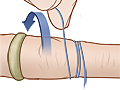
- Remove all jewelry.
Remove rings, anklets, and any other jewelry that goes around your leg, ankle, or toe. It will be hard to remove the jewelry after swelling starts.
- Rest.
It's important to rest and protect the affected area.
- Use ice.
Put ice or a cold pack on the affected area for 10 to 20 minutes at a time. Try to do this every 1 to 2 hours for the next 3 days (when you are awake).
- Wrap the affected area.
Compression, or wrapping the area with an elastic bandage (such as an Ace wrap), will help reduce swelling. Don't wrap it too tightly, because that can cause more swelling below the affected area. Loosen the bandage if it gets too tight. Signs that the bandage is too tight include numbness, tingling, increased pain, coolness, and swelling in the area below the bandage.
- Elevate the affected area.
Try to keep the area at or above the level of your heart to help reduce swelling. Prop up the area on pillows while you apply ice and anytime you sit or lie down.
- Stop, change, or take a break from any activity that causes your symptoms.
- Avoid "running through the pain." It may increase damage to your foot.
- Try changing your exercise routine if you think running or another high-impact sport is causing your foot pain. Switch to a low-impact exercise activity for a while. Try things like cross-country skiing, stair-climbing machines, biking (regular or stationary), rowing, and swimming.
- Use sensible sports-training techniques. For example, wear the right shoes, and stretch before activities.
- Avoid more swelling.
For 48 hours, avoid things that might increase swelling. These things include hot showers, hot tubs, hot packs, and drinks that contain alcohol.
- Apply heat.
- After 2 or 3 days, you can try applying heat to the area that hurts. Types of heat therapy include microwavable packs and disposable heating patches.
- Apply heat for 10 to 20 minutes at a time.
- You might also try switching between cold and heat.
- Take care of blisters.
Try using a donut-shaped moleskin pad. Leave the area over the blister open. Home treatment for blisters depends on whether the blister is small or large and whether it has broken open.
- Try massage.
Gently massage your feet to reduce discomfort, relax your feet, and promote circulation.
- Choose your footwear carefully.
- Wear comfortable and supportive shoes and socks. Look for roomy footwear, and avoid high heels.
- Try using an orthotic shoe device, such as an arch support. It may help relieve your foot pain.
- Do foot exercises.
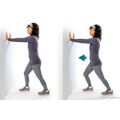
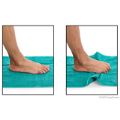
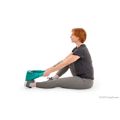
Try heel-cord exercises to increase your strength and flexibility, if your heel or heel cord (Achilles tendon) is tight and painful. Try a standing calf stretch, towel scrunch, or seated calf stretch using a towel. These may help relieve your heel pain.
If you need to use a wrap for more than 48 hours, you may have a more serious injury that needs to be checked by a doctor.
Treating swollen ankles and feet
Try the following tips to help reduce swelling in your ankles and feet.
- Elevate your swollen feet and ankles.
Put them on a footstool or pillow (above the level of your heart) when you sit for any length of time.
- Move around.
Get up and walk around for a few minutes every hour if you sit for any length of time.
When to call for help during self-care
Call a doctor if any of the following occur during self-care at home:
- New or worse pain or swelling.
- New signs of infection, such as redness, warmth, pus, or a fever.
- New or worse numbness, tingling, or cool and pale skin.
- Movement or strength decreases.
- Symptoms occur more often or are more severe.
Learn more
Over-the-counter medicines
- Acetaminophen
- Aspirin for Pain, Fever, and Inflammation
- Nonsteroidal Anti-Inflammatory Drugs (NSAIDs)
- Quick Tips: Safely Giving Over-the-Counter Medicines to Children
More self-care
Watch
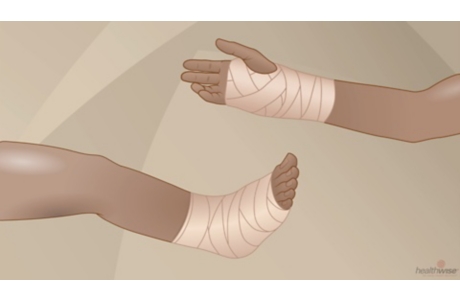
Preparing For Your Appointment
You can help your doctor diagnose and treat your condition by being prepared for your appointment.
Related Information
Credits
Current as of: October 24, 2023
Author: Healthwise Staff
Clinical Review Board
All Healthwise education is reviewed by a team that includes physicians, nurses, advanced practitioners, registered dieticians, and other healthcare professionals.
Current as of: October 24, 2023
Author: Healthwise Staff
Clinical Review Board
All Healthwise education is reviewed by a team that includes physicians, nurses, advanced practitioners, registered dieticians, and other healthcare professionals.