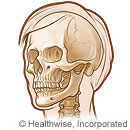
Temporomandibular disorders (TMD) is the name given to several problems with jaw movement and pain in and around the jaw joints.
You may also hear TMD called TMJ or TM problems.
The jaw joints, or temporomandibular (TM) joints, connect the lower jawbone (mandible) to the skull. These flexible joints are used more than any other joint in the body. They allow the jaw to open and close for talking, chewing, swallowing, yawning, and other movements.
Many people have problems with jaw movement and pain in and around the jaw joints at some time during their lives. These joint and muscle problems are complex. So finding the right diagnosis and treatment of TMD may take some time.
What are the symptoms?
Temporomandibular disorders (TMD) can affect the jaw and jaw joint as well as muscles in the face, shoulder, head, and neck. Common symptoms include joint pain, muscle pain, headaches, joint sounds, trouble with fully opening the mouth, and jaw locking.
In most cases, symptoms of TMD are mild and don't last long. They tend to come and go without getting worse and usually go away without a doctor's care.
Some people who have TMD develop long-lasting (chronic) symptoms. Chronic pain or difficulty moving the jaw may affect talking, eating, and swallowing. This may affect a person's overall sense of well-being.
What causes temporomandibular disorders?
The most common cause of TMD symptoms is muscle tension, often triggered by stress. When you are under stress, you may be in the habit of clenching or grinding your teeth. These habits can tire the jaw muscles and lead to a cycle of muscle spasm, tissue damage, pain, sore muscles, and more spasm.
TMD can start when there is a problem with the joint itself, such as:
An injury to the joint or the tissues around it.
Problems with how the joint is shaped.
Joint diseases, such as osteoarthritis or rheumatoid arthritis.
The articular disc that cushions the joint shifts out of place.
How is a temporomandibular disorder diagnosed?
Although there is no one way to identify a TMD, your doctor can most likely check your condition with a physical exam and by asking questions about your past health. In some cases, an X-ray, CT scan, or MRI is also used to check for bone or soft tissue problems related to symptoms of TMD.
How is it treated?
TMD symptoms usually go away without treatment. Simple home treatment can often relieve mild jaw pain. There are things you can do at first to reduce pain.
Rest your jaw joint.
Use medicines for a short time, to reduce swelling or relax muscles.
Put either an ice pack or a warm, moist cloth on your jaw for 15 minutes several times a day if it makes your jaw feel better. Or you can switch back and forth between moist heat and cold. Gently open and close your mouth while you use the ice pack or heat.
Eat soft foods. And avoid chewy foods and chewing gum.
Getting physical therapy and learning ways to reduce stress may also help to reduce pain and TM joint problems. Continue to use some of these methods over time to prevent and manage symptoms that might come back. If your pain is chronic or severe or is caused by problems with how the joint is shaped, your doctor may recommend other treatments.
Splints, also called bite plates, are a common dental treatment for TMDs. Splints are usually clear pieces of plastic that fit between the upper and lower teeth. They help reduce grinding and clenching. Splints are used for a short time so that they do not cause permanent changes in the teeth or jaw.
Before you try treatments such as surgery or reshaping or shaving down the teeth, think it over. These treatments cannot be reversed and can even damage the TM joint.
For most people, surgery is not used to treat TMDs. Surgery has few benefits, and there is the chance of causing more serious problems. You and your doctor can carefully weigh a decision to have surgery. Talking with another doctor to get a second opinion can also help you make your decision.
Chronic pain can lead to depression, anxiety, and other problems. If you have chronic pain, talk to your doctor about medicine and mental exercises to manage the pain. Give special attention to treating any related anxiety or depression.
Health Tools
Health Tools help you make wise health decisions or take action to improve your health.
Decision Points focus on key medical care decisions that are important to many health problems.
Temporomandibular disorders (TMD) can result from a single cause or, more commonly, a combination of causes.
The main causes of TMDs include:
Muscle tension (tightness) and spasm. Muscle tension in the jaw, face, head, neck, and shoulders may make your jaw feel achy, stiff, and painful, especially when moving your jaw. Muscle tension may be:
Caused by stress and anxiety and by stress-related habits, such as daytime or nighttime clenching or grinding of your teeth (bruxism), excessive gum chewing, or nail biting.
A response to injury or structural problems within the joint.
Problems in the internal structure of the joint, such as:
Displacement of the disc that cushions the joint.
Degenerative disease, such as osteoarthritis or rheumatoid arthritis, which causes inflammation and destruction of the joint tissues.
Scar tissue or bone damage caused by accidental injury or a blow to the jaw.
Disease, such as a tumor, or structural problems present at birth (congenital).
In many cases, TMD symptoms appear to be caused by both muscle tension (tightness) and joint dysfunction. It is not always clear which came first. For example, osteoarthritis can cause changes in the joint, which may then bring on muscle spasms. Conversely, muscle spasms over time hinder jaw function and can eventually cause osteoarthritis in the jaw joint. A similar relationship appears to exist between muscle tension and disc displacement within the joint.
When jaw joint problems are caused by diseases such as rheumatoid arthritis, treatment for that condition is important. Many other conditions cause symptoms similar to those of TMDs, such as migraine headaches and infections.
Symptoms
Symptoms of temporomandibular disorders (TMDs) are usually mild and temporary and typically do not get worse with time. Common symptoms include:
Joint pain when the jaw is moving, as when opening the mouth widely, chewing, or yawning. Such pain can occur:
Usually on one side of the jaw, but it can be on both sides.
Either gradually or suddenly, as when biting down on something hard or following a blow to the jaw.
Headaches. In children with TMDs, headaches are often related to grinding the teeth (bruxism).
Clicking, popping, cracking, or grating that is painful and occurs when opening the jaw (may be a sign of disc displacement). Clicking or popping noises without pain are common and do not require treatment.
The jaw locking in an open or closed position or not opening wide (disc displacement). If the jaw locks for more than a few moments, a muscle spasm usually follows.
Sometimes pain around the ear, with pressure or ringing in the ears (tinnitus), develops with TMDs. Some people with these symptoms report that they also have hearing loss, although test results show that their hearing is normal.
Symptoms often go away on their own. And they may recur over time without getting much better or worse. Occasional discomfort in the jaw joint or chewing muscles is quite common and usually is not a cause for concern. But for some people symptoms can be very painful, disabling, and last a long time.
What Happens
The course of temporomandibular disorders (TMDs) caused by muscle tension varies depending on the cause of the muscle tension.
If muscle tension is related to a one-time overuse injury (such as holding your mouth open for a long time during a dental exam), the pain and discomfort may go away without treatment.
If there is long-lasting (chronic) muscle tension due to stress, anxiety, an injury or blow to the jaw, or habits like grinding the teeth during sleep, treatment (including changing certain habits) may relieve pain and discomfort. If chronic muscle tension is not treated, it may gradually cause changes in the joint structure or osteoarthritis.
Respond well to nonsurgical treatment, if treated early.
Get worse, if not treated. Long-term consequences include injury to the disc or other tissues in the joint, arthritis, or chronic pain.
Chronic pain
In some cases, TMDs can be extremely painful and disabling and last a long time. Such chronic pain can affect a person's overall quality of life by increasing stress, making it hard to do a job, and interfering with personal life. Depression and anxiety are common results of chronic pain. Treatments may not relieve pain due to the lasting psychological and biological impact of chronic pain. These biological effects can lead to a sense of helplessness and biochemical changes in the body that perpetuate pain. In these cases, it is especially important to seek treatment for TMD pain and for related depression and anxiety.
What Increases Your Risk
Risk factors for temporomandibular disorders (TMDs) include:
Stress and anxiety, which can cause facial and jaw muscle tension.
Repetitive habits, such as grinding your teeth (bruxism), clenching your teeth, excessive gum chewing, eating hard or chewy foods, and nail biting.
Habits that can cause muscle tension, such as sleeping on one side of your face or with your mouth open, opening your mouth wide when yawning or singing, or holding your head up by cradling your jaw in your hand.
Injury to the jaw or head. TMDs can result from a direct blow to the jaw, chin, or head; whiplash to the head or neck; overstretching the jaw during dental work or surgery; or other injuries that may lead to joint damage or muscle tension.
Age and gender. TMDs are more common in younger adults (ages 20 to 50) and in women.footnote 1
When should you call your doctor?
Call your dentist or doctor immediately if you have had an injury to your jaw or face and:
Your jaw is very painful.
Your jaw is locked open or shut, or you are unable to move your jaw easily or smoothly (a sign of disc displacement, dislocation, or fracture).
Your jaw appears to be deformed or swollen.
There is swelling in the sides of your face.
Your teeth no longer fit together normally when biting down (malocclusion).
A severe headache or neck ache strikes suddenly, without apparent cause, or is different from previous headaches.
Call your dentist or doctor if you:
Have pain when moving your jaw (biting, chewing, swallowing, talking, or yawning) that is not getting better after 2 weeks of home treatment.
Have had jaw pain for a long time (chronic).
Have anxiety, stress, or work-related problems caused by your jaw discomfort and pain.
Continue to have symptoms (such as pain with clicking or cracking sounds or your jaw locks) after 2 weeks of home treatment.
Notice a change in the way your teeth fit together when you close your mouth.
Who to see
Your treatment for temporomandibular disorder (TMD) may involve several different health professionals.
If a doctor suggests that you try a treatment that might make permanent changes to your jaw, be sure to get a second opinion.
Health and dental insurance plans might not cover diagnosis and treatment. Because some tests and treatments are quite expensive, you may want to check your coverage before incurring expenses.
Exams and Tests
Currently there is no widely accepted standard test for identifying the cause of temporomandibular disorders (TMDs). But your dentist or doctor will most likely be able to accurately diagnose your condition with information from a medical history and physical exam.
Most TMDs are caused or made worse by muscle tension (tightness). Expect your doctor to suggest treatment that does not involve surgery or permanent changes to the jaw (conservative treatment) to relieve your jaw pain, muscle tension, and TM joint problems.
If you have sudden pain after a facial or jaw injury, your doctor is likely to order some type of imaging test, such as an X-ray, a CT scan, or magnetic resonance imaging (MRI).
If conservative treatment has not worked
If conservative treatment has not worked and your jaw is locking in place (a sign of disc displacement), your pain is severe or chronic, or you have other medical problems, such as rheumatoid arthritis, other tests may be needed. These tests are usually done only if knowing their results could change your recommended treatment plan.
If you still have symptoms after the first period of treatment, your doctor may begin to look for problems in the jaw joint structure. Other tests may include:
X-ray. This test can confirm whether the bones are worn away, broken, or disfigured. If disc displacement is suspected, X-rays may be helpful to show the size of the joint space. A narrow joint space can be a sign that the disc is affected.
Magnetic resonance imaging (MRI). A view of the soft tissues (ligaments, muscles, and articular disc) is useful in showing disc displacement or damage. Although expensive, MRI is thought to be the most effective imaging technique for assessing TMDs that may involve disc problems.
Treatment Overview
The goal of treatment for temporomandibular disorders (TMDs) is to relieve pain in the jaw and restore normal jaw movement and function. Several treatment approaches are effective. The first treatments that are tried for TMDs are called conservative, because they are simple and temporary. They are not invasive or permanent. They can be stopped or reversed. They include over-the-counter pain medicine and self-care that you can do at home.
Often, simple home treatment measures can successfully relieve jaw pain. Less than 1 out of 10 adults have jaw problems or pain that is so severe that they need medical or dental treatment.footnote 1
For chronic, muscle-related TMDs, standard medical care can include muscle relaxation measures, biofeedback, stress management, or cognitive-behavioral therapy.
For chronic pain caused by a TMD, it is important to seek treatment for pain and for related depression and anxiety.
Dental splints are the most common dental treatment for TMDs. These splints or bite plates are typically used for a short period of time. They can help relieve muscle tension and pain.
Most people do not need permanent dental work or surgery. Permanent dental work might include orthodontic treatments involving permanent changes to the jaw. At best, permanent treatments or surgery may not work any better than physical therapy and temporary treatments. At worst, they can cause irreversible damage. If your doctor recommends surgery or other treatment that involves permanent changes, be sure to get a second opinion before you start treatment.
Often, structural problems in the jaw, such as disc displacement, can be improved with conservative (nonsurgical) treatment, especially when they are treated early.
Health and dental insurance plans might not cover diagnosis and treatment. Because some tests and treatments are quite expensive, you may want to check your coverage before incurring expenses.
Prevention
To prevent temporomandibular disorders (TMDs), try to reduce muscle tension in your jaw. You can reduce muscle tension in these ways:
Relax. If you have a lot of stress and anxiety in your life, try relaxation techniques. See the topic Stress Management.
Learn to recognize when you are clenching your teeth. Practice keeping your teeth apart, bringing them together only when swallowing or eating. When driving, avoid clenching the wheel with both hands, because often your teeth will be clenched also.
Do not overuse and stress your jaw muscles. Avoid constantly chewing gum, biting your nails, resting your chin on your hand, or cradling the telephone receiver between your shoulder and jaw.
Change your diet. Eat softer foods, and use both sides of your mouth to chew your food. Avoid hard or chewy foods, such as popcorn, apples, carrots, taffy, hard breads, and bagels.
Maintain good posture. Poor posture may disturb the natural alignment of your facial bones and muscles, causing pain.
In the past, various procedures such as dental restoration and orthodontic treatment were used to prevent joint sounds from developing into TMDs. Such measures are not only unneeded but also potentially damaging to a joint that may never become painful on its own.
See Home Treatment for other ways to prevent or reduce muscle tension in your jaw.
Home Treatment
If your temporomandibular disorder (TMD) symptoms are mild, try home treatment for at least 2 weeks. If your symptoms don't get better or if they get worse during this time, call your doctor or dentist.
Home treatment involves reducing your stress, resting your jaw (by eating only soft or pureed foods), taking steps to reduce pain, and exercising your jaw.
To help relieve pain and restore jaw function:
Try comfort measures such as moist heat, ice, or nonsteroidal anti-inflammatory drugs (NSAIDs), such as ibuprofen or naproxen.
Do jaw exercises as prescribed by your doctor or physical therapist. Also, pay attention to your jaw, and relax it when you are tense.
Change your diet to decrease jaw strain. For example, avoid hard or chewy foods.
Manage stress. Many people tend to clench or tighten their muscles when they are under stress of any kind.
If you have been diagnosed with a TMD, these home treatment measures will optimize the treatments prescribed by your doctor or dentist, such as a splint therapy or physical therapy.
Medications
You can use medicine to relieve the pain of a temporomandibular disorder (TMD). Short-term use of nonsteroidal anti-inflammatory drugs (NSAIDs), opioids, muscle relaxants, or antidepressant medicines can relieve or reduce inflammation, control pain, and relax the jaw muscles. Be safe with medicines. Read and follow all instructions on the label.
Opioid pain relievers (such as acetaminophen with codeine or hydrocodone) are used in some cases of acute, severe pain. Because opioid use can lead to opioid use disorder, they are usually not taken long-term.
Muscle relaxants, such as cyclobenzaprine (Flexeril) or diazepam (Valium), are used in some cases of acute pain or prolonged muscle spasm. Because they are addictive, sedating, and can cause depression or make it worse, muscle relaxants should be taken at the lowest possible dose and are usually not used long-term.
Low doses of tricyclic antidepressants, such as amitriptyline, are used in cases of chronic pain. These medicines might also be used if you have a disrupted sleep pattern, which can cause you to grind your teeth (bruxism).
What to think about
Nonsteroidal anti-inflammatory drugs (NSAIDs) do not cure TMDs. But they may reduce pain and inflammation, which allows you to do prescribed jaw exercises that can start the healing process. NSAIDs may be prescribed on a regular basis for 1 to 2 weeks to help reduce inflammation even though the pain has subsided.
Your doctor may prescribe an antidepressant, not necessarily because you suffer from depression but to help treat chronic pain or nighttime bruxism.
Surgery
Surgery is rarely used to treat temporomandibular disorders (TMDs). Surgical treatment does not guarantee a cure and can further damage the temporomandibular joint. Because most TMDs can be treated nonsurgically, most doctors believe that surgery should be the last option tried and should be avoided if possible.
Surgery may be a treatment option for you if both of the following apply:
Other treatments have failed, and chronic jaw pain and dysfunction have become disabling.
There are specific, severe structural problems in the jaw joint. These include scar tissue in the joint area, problems with bone alignment, broken or degenerated bones, and occasionally disc displacement or perforation.
Arthrocentesis. This is not a true surgery, since there is no incision. But it is an invasive procedure done by an oral and maxillofacial surgeon.
Surgery may include:
Arthroscopic procedures, including washing out the joint area (lavage), cutting or removing scar tissue that is blocking joint movement (lysis), cutting tissue that has shortened and is impeding joint function, or shaving part of the disc.
Open joint arthroplasty, used for disabling joint problems that aren't easily reached or viewed arthroscopically.
Another type of surgery, called total joint replacement, is rarely done. It has sometimes resulted in permanent jaw damage. Total joint replacement replaces the jaw joint with artificial parts. In some cases the artificial parts have not worked correctly or have broken. The available technology for this surgery is still considered to be experimental and risky.
What to think about
Further pain complications or joint dysfunction can result from temporomandibular joint surgery.
Surgery is not needed in most cases of disc displacement.footnote 2 Splint therapy (a dental treatment), jaw rest, and physical therapy, including moist heat and jaw exercises followed by an ice pack, can work very well for treating this condition. If this and other nonsurgical treatment to relax the muscles are not successful, arthrocentesis may effectively treat your condition.
If you are thinking about surgery, get a second opinion on your condition and treatment.
Other Treatment
Many types of treatment can successfully relieve temporomandibular disorder (TMD) symptoms. Different doctors will suggest different treatments, any of which may work to relieve jaw and facial pain.
If a doctor recommends that you try a treatment that might make permanent changes to your jaw or teeth, get a second opinion.
Other treatment choices
Depending on your condition, one of the following choices may be more effective than another. Safe options for treatment of TMD include:
Some dental treatments, including splint therapy to relieve pressure on the TM joint.
Many different types of treatment for temporomandibular disorders (TMD) have potential for successfully relieving your condition. If your problem is linked to muscle tension, any treatment that helps you relax your jaw muscles with no adverse effects is likely to be helpful. Different treatments work for different people.
Treatments vary greatly in safety, cost, and how well they work.
Scrivani SJ, et al. (2008). Temporomandibular disorders. New England Journal of Medicine, 359(25): 2693–2705.
Tucker MR, et al. (2008). Management of temporomandibular disorders. In JR Hupp et al., eds., Contemporary Oral and Maxillofacial Surgery, 5th ed., pp. 629–649. St. Louis: Mosby Elsevier.
Other Works Consulted
American Academy of Pediatric Dentistry (2010). Guideline on acquired temporomandibular disorders in infants, children, and adolescents. American Academy of Pediatric Dentistry Clinical Guidelines Reference Manual, 32(6): 232–237. Also available online: http://www.aapd.org/media/policies.asp.
American Association for Dental Research (2010). Temporomandibular Disorders (TMD). Available online: http://www.aadronline.org/i4a/pages/index.cfm?pageid=3465#TMD.
American Society of Temporomandibular Joint Surgeons (2003). Guidelines for diagnosis and management of disorders involving temporomandibular joint and related musculoskeletal structures. Cranio, 21(1): 68–76.
Goddard G (2008). Temporomandibular disorders. In AK Lalwani, ed., Current Diagnosis and Treatment in Otolaryngology – Head and Neck Surgery, 2nd ed., pp. 389–396. New York: McGraw-Hill.
Okeson JP (2011). Temporomandibular disorders. In ET Bope et al., eds., Conn's Current Therapy 2011, pp. 1008–1011. Philadelphia: Saunders.
Credits
Current as of:
March 25, 2020
Author: Healthwise Staff Medical Review: Adam Husney MD - Family Medicine Martin J. Gabica MD - Family Medicine Kathleen Romito MD - Family Medicine
Medical Review:Adam Husney MD - Family Medicine & Martin J. Gabica MD - Family Medicine & Kathleen Romito MD - Family Medicine
Scrivani SJ, et al. (2008). Temporomandibular disorders. New England Journal of Medicine, 359(25): 2693-2705.
Tucker MR, et al. (2008). Management of temporomandibular disorders. In JR Hupp et al., eds., Contemporary Oral and Maxillofacial Surgery, 5th ed., pp. 629-649. St. Louis: Mosby Elsevier.
This information does not replace the advice of a doctor. Healthwise, Incorporated, disclaims any warranty or liability for your use of this information. Your use of this information means that you agree to the Terms of Use. Learn how we develop our content.